Other work
smaller projects
-
Software engineering agents in MiniGrid
A paper introducing LLMs as policy generators to solve environments, in the case of MiniGrid. It adapts Mini-SWE-Agent, an existing software-engineering agent, to write controllers for 20 MiniGrid tasks, and compares its results with and without access to the environment’s source code and with different possibilities for interactive exploration. It is a proof of concept for software-engineering agents in interactive games; it does not use Regact.
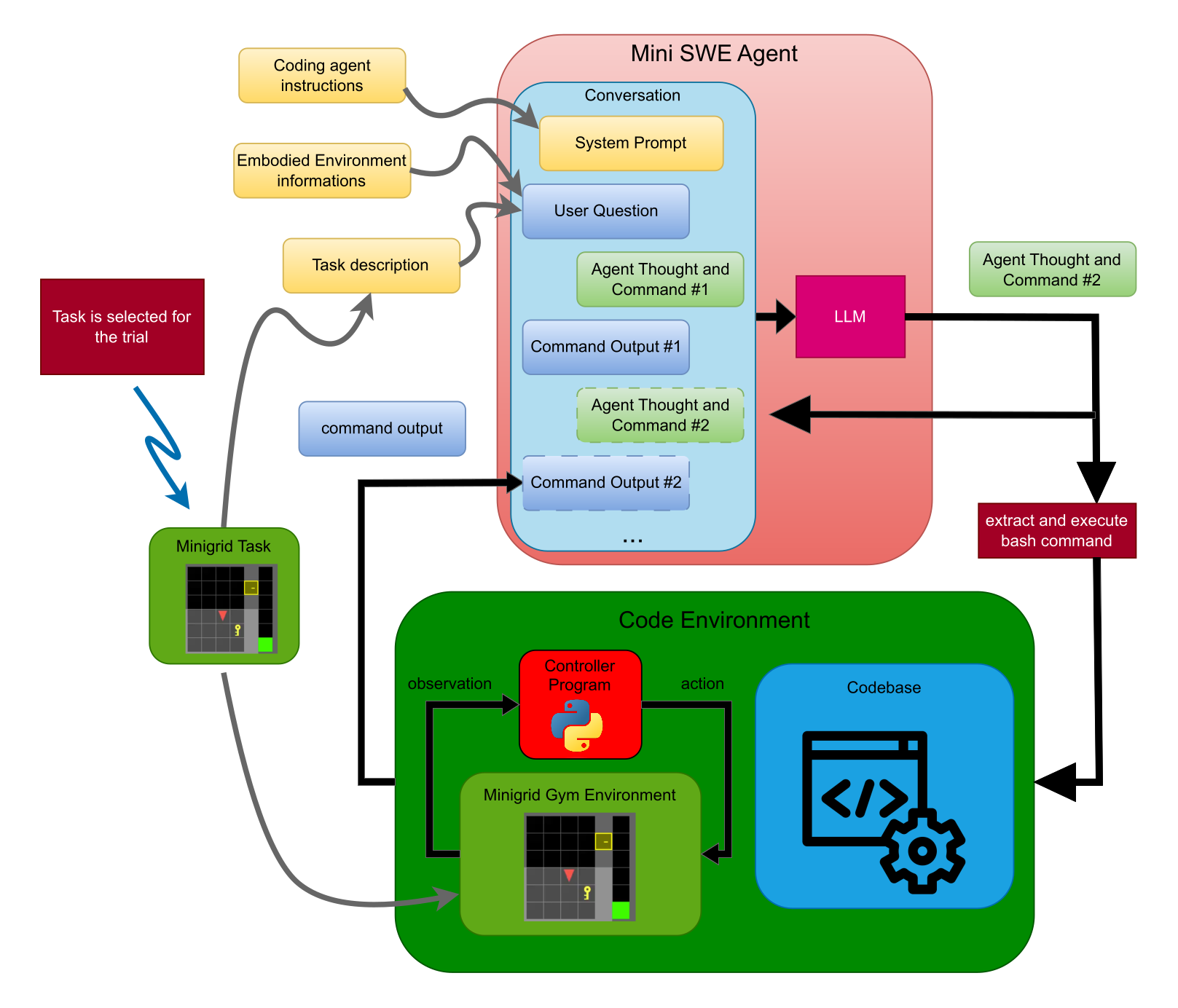
Figure 1 of the paper (arXiv:2510.21902). -
Algorithms for Normal-Form Games
A research project on multi-agent learning algorithms for normal-form games (Matching Pennies, Rock-Paper-Scissors, a normal-form version of Kuhn Poker), tracking how far the agents’ policies are from a Nash equilibrium. It introduces PAL-FoReL, a population-based extension of Iterated Lyapunov FoReL that converged much faster than it in the project’s experiments. The project report is in the repository.
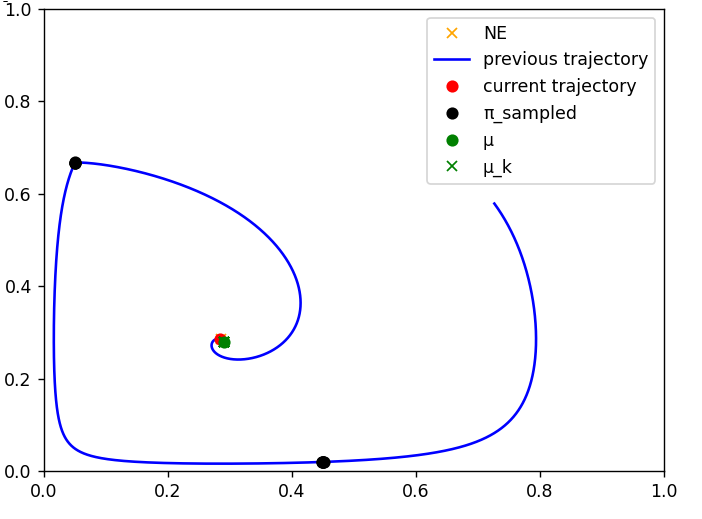
The joint policy of PAL-FoReL on a biased Matching Pennies game, whose only Nash equilibrium is (2/7, 2/7). Each axis is one agent’s probability of playing action 0. -
EcoJAX
A modular JAX codebase for experiments on ecosystems of neural agents. Agents live, reproduce and die in a gridworld, and their neural networks are evolved by a genetic algorithm as they inherit from their parents. The population has a fixed maximum size, so that every array stays batched for JAX.
A simulation in EcoJAX’s gridworld: agents in blue, food in green.